
Language concepts are the foundational skills that support the development of reading comprehension. In this post, you’ll discover the essentials to teaching language concepts skills.
Plus, explore five free books available in both English and Spanish!
The Elements of Language Concepts
Teaching language concepts involves a wide range of skills that help students understand how written language works. In Scarborough’s Reading Rope, these skills are part of the strands known as Literacy Knowledge and Language Structures.
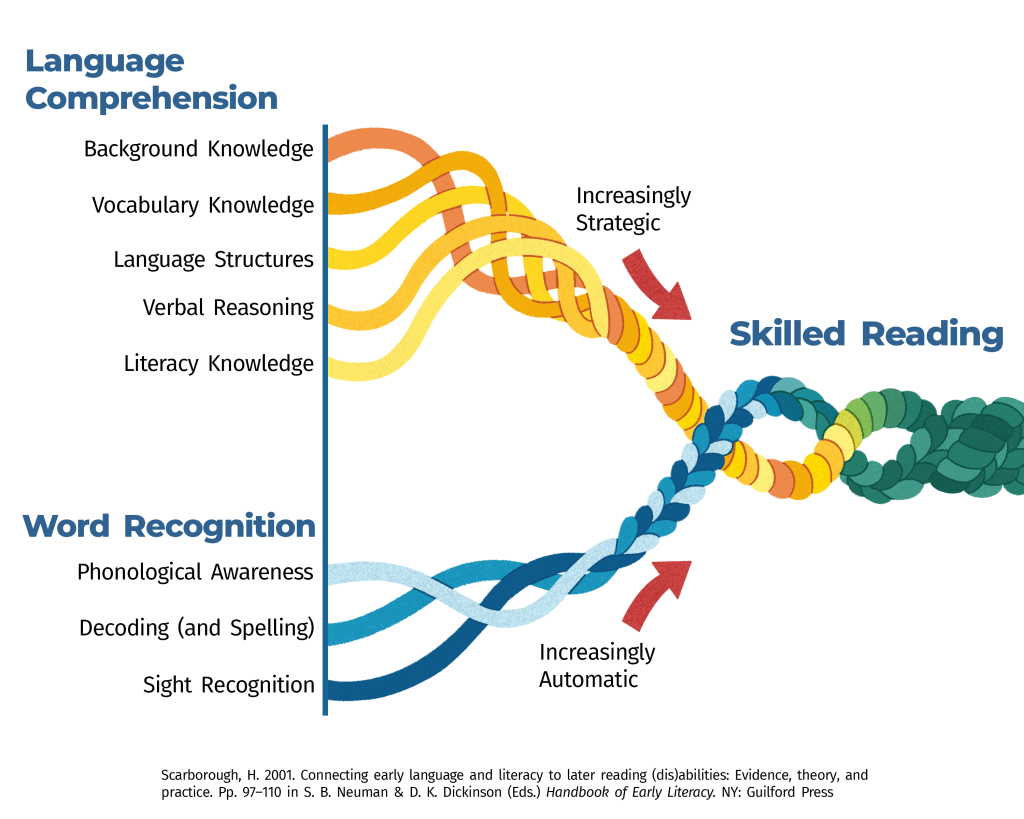
- Literacy knowledge includes understanding print concepts, recognizing different genres, and identifying common text features.
- Language structures focus on skills such as using punctuation, identifying parts of speech, and understanding sentence structure.
Let’s take a closer look at these two important parts of language concepts.
Literacy Knowledge
Print concepts
Young learners develop strong print awareness by understanding the following:
- Print represents spoken language
- In English, text is read from left to right
- Letters can be arranged in specific ways to create words
- Words are separated by spaces
- Words can be combined to make sentences that convey ideas
- Sentences end with punctuation marks
Genres
The more book genres that a student encounters—including narrative and informational text, biography, folktales, and poetry—the more their vocabulary and background knowledge will grow. Vocabulary and background knowledge are important building blocks for reading comprehension.
Having many genres available in a classroom or school library also helps students learn that people read for different reasons. For example, they might read a fantasy book for fun or choose a science book to learn about animals.
Text features
Text features include things like:
- The table of contents
- Headings
- Captions
- Graphs and visual information
- Glossaries, and more.
Understanding and using these features within texts supports reading comprehension.
Language Structures
 Punctuation
 Punctuation
Knowledge of the functions of punctuation supports both reading fluency and comprehension.
Parts of speech
Teaching parts of speech helps students understand how different types of words—like nouns, pronouns, verbs, adjectives, adverbs, prepositions, interjections, and conjunctions—each have a specific job in a sentence.
When students understand how these parts work together, they are better able to make sense of sentences and longer texts. This supports stronger reading comprehension.
Syntax
Syntax is the study of how words are ordered to make meaningful phrases and sentences. Building students’ syntactic awareness helps sentence-level comprehension. And that leads to stronger overall comprehension of texts. Syntactic awareness also helps students build strong writing skills.
Strategies for Teaching Language Concepts
Teaching language concepts is a key part of literacy instruction. Understanding language concepts helps students understand the way written language is organized.
As these skills are taught, it is important to tie them to meaningful texts. After all, the goal of reading is to understand the meaning of the text. To teach language concepts effectively, educators can:
- Model and teach print concepts for the youngest learners with frequent, rich experiences with both narrative and informational texts.
- Incorporate a wide range of genres to help students explore different themes and subjects as they build vocabulary and background knowledge.
Preview books as a class to spotlight text features and consider how they can be used for understanding. Teach students to ask questions such as:
- How can I use the table of contents to think about what ideas are included in this book?
- What extra information can I learn from pictures, graphs, and other visuals in the book?
- How can the headings help me organize my thoughts as I read?

Draw students’ attention to punctuation within texts. Help them think about how punctuation helps us understand important elements of a story, like how characters are feeling or when a character is speaking.
Teach about how different parts of speech each play a role in contributing to the meaning of a text. How can verbs, nouns, and adjectives support understanding by answering questions about who, what, when, where, why, and how?
Explore syntax within a text. Help students understand how words are arranged to build meaningful sentences. Find sentences that join ideas using the word “but,” “so,” or “because.” Help students practice writing their own sentences that follow the same structure.
Christensen also said it can be helpful to link language concept instruction to a theme or topic you’re teaching in class. That way, students are building content knowledge that also supports reading comprehension.
5 Free Books to Teach Language Concepts
The free books linked below represent a range of genres and can be used to teach a variety of language concepts skills. Share these books with teachers in your school to use in class or send to families as a home learning activity.
Nursery Rhyme: The Itsy, Bitsy Spider (Spanish) Foster print concepts skills by reciting this well-known rhyme as you track print from left to right and point to each word to model the connection between speech and print.
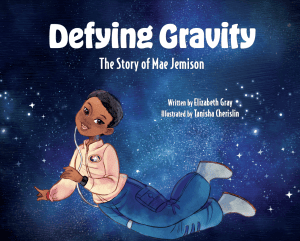
Biography: Defying Gravity: The Story of Mae Jemison (Spanish) Examine the text features in this book. What extra information can be gathered from the timeline or the diagram of our solar system? What can be learned from the glossary?
Folktale: The Little Red Hen (Spanish) Find punctuation in the book. How do question marks, exclamation points, and quotation marks help us understand the story?
Poetry: Annie Can Whistle and Other Poems (Spanish) Use this book of poems to explore parts of speech. Pay special attention to adjectives. Many poems describe feelings or experiences, so adjectives play an important role.
Informational Text: Water (Spanish) As you help students learn about the water cycle, you can also help them learn about syntax. Look for sentences that use the word “and” to combine two ideas. Next, look for two shorter sentences. Can you use the word “and” to combine them to form one sentence?
Explore Science of Reading Resources for Educators
Read Waterford’s Science of Reading article series to learn about research-based instructional strategies for creating classroom lesson plans. Get started with:
- How to Teach Phonics & Decoding Skills
- Strategies for Teaching Reading Comprehension
- Ways to Teach Communication Skills
Find on-demand video series led by early education experts through Waterford’s Science of Reading Webinar Library, featuring topics chosen with educators in mind like:
- An Overview of the Science of Reading: From Research to Instruction
- Phonological Awareness: The Structure of Spoken Language
- Professional Learning: Teaching the Science of Reading
- And more!
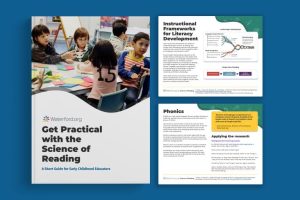
Download ‘Get Practical With the Science of Reading’
Find out more about the latest in the Science of Reading. Download this free ebook to explore the latest research on the science of reading, methods to teach phonics and decoding skills, and more.