
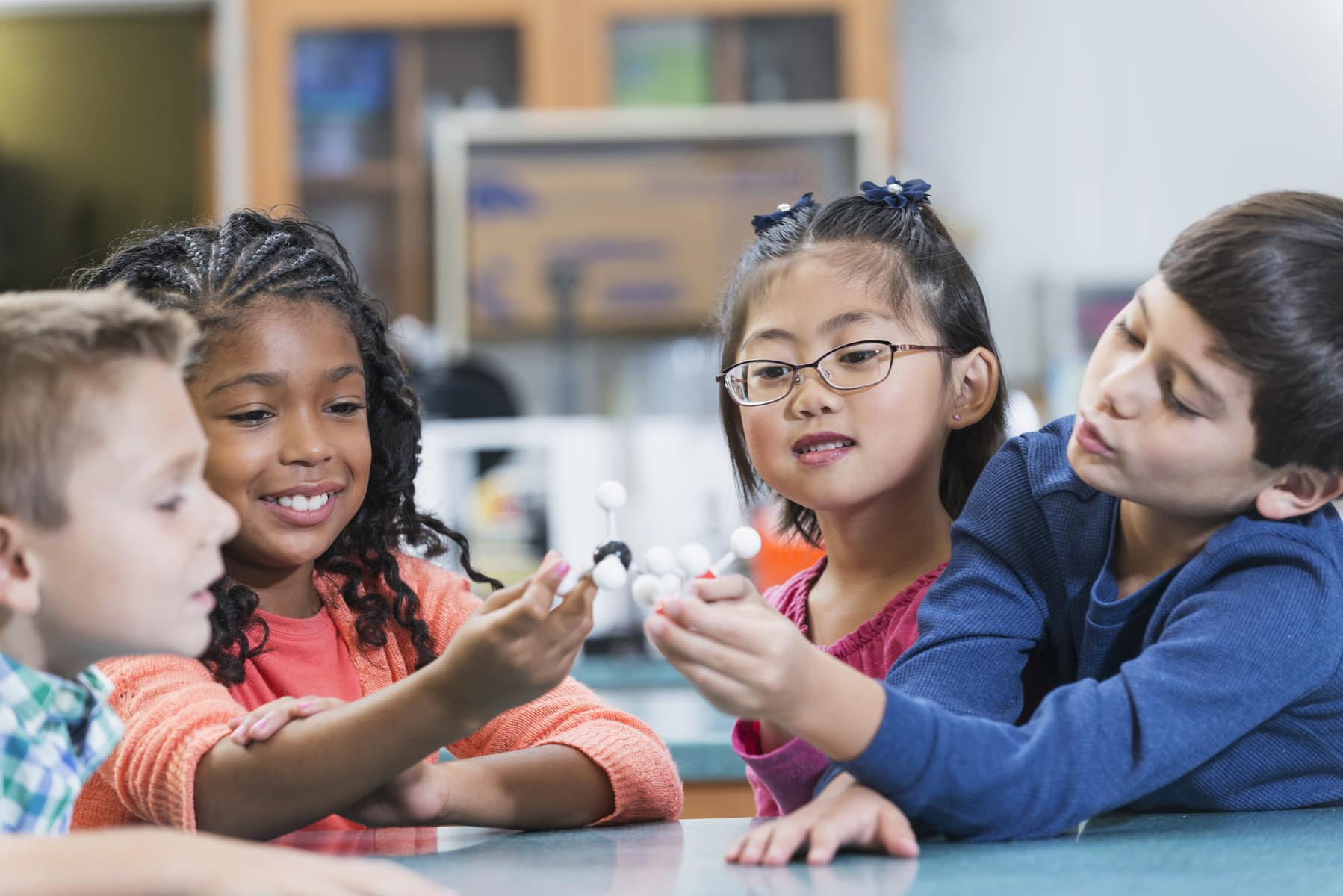
Waterford.org helps children build confidence in their science learning. Bring their discoveries to life with simple, hands-on experiments using everyday items. Whether they’re melting crayons or watching a chemical reaction fizz and bubble, nothing boosts a child’s understanding of science like exploring it firsthand. Spark their curiosity and encourage them to investigate the world around them with these 10 fun, easy science activities you can do together at home.
1. Mentos and Coke
This classic science experiment helps kids discover the power of chemical reactions using two ingredients. Kids love this experiment because it creates a fast-rising fountain powered by a rapid reaction between Coke and Mentos. All you need for this experiment is a bottle or can of Coke and a few Mentos. When the Mentos gets dropped into the open coke, the candy’s rough surface helps carbon dioxide bubbles form extremely quickly, forcing the soda upward in a big, foamy burst. Step back and watch the reaction shoot into the air.
https://www.kidssciencelabs.com/blog/top-32-easy-science-experiments-for-kids-at-home
2. Learn the colors with food dye
Help your child learn all about how colors mix with this simple activity. You’ll need six clear containers and some food dye. Fill three containers with water and add red, yellow, and blue food color – one color per container. Then, pour the red and blue water into another container, the red and yellow water in a second container and yellow and blue water in the last one. Watch as new colors appear. For an extra challenge, mix the colors in different amounts and different colors and predict what colors will form.
https://www.mymundaneandmiraculouslife.com/simple-color-mixing-science-experiment-for-preschoolers/
3. Discover fossils in ice
Gather paper cups and fill them with water. Place small toys in the water like marbles, small animals, and paperclips. Place the cups in the freezer. Once frozen, use different tools like forks to chip away at the ice and discover what’s hidden inside. This activity teaches kids the fun of discovering the unknown and is a great opportunity to teach them about safety with experiments.
4. Learn about heat by melting crayons on cardstock
Tape or hot glue unwrapped crayons to a piece of cardstock or another sturdy art surface like cardboard. Use a blow dryer to blow warm the crayons and watch as the wax melts across the surface making a piece of art full of patterns and colors. For an added challenge, encourage kids to predict how the wax will move or try specific color combinations to see how they blend as they melt.
https://www.youtube.com/watch?v=-U7j83tRe3s
5. Pencils through a plastic bag, polymers
Fill a plastic bag with water, then take sharpened pencils or pens and gently push them through the bag. The water stays inside because the stretchy plastic forms a snug seal around each pencil. As long as the pens and pencils stay in place, so will the water. This is a kid-friendly way to show how the plastic’s long, flexible chains (called polymers) can move and stretch without breaking.
https://mybrightwheel.com/blog/science-activities-for-preschoolers
6. Find leaves and color over them
Gather a few leaves from outside and place a piece of paper on top of them. Using a crayon, gently color over the paper until the leaf’s shape and veins appear. Help your kids learn about their tiny “leaf skeleton” by showing them how the veins help the leaf stay strong and move nutrients.
7. Oil vs Water
Fill a plastic water bottle half-way with water (for some extra fun, dye the water). Add a little bit of oil to the water bottle. Shake the water bottle around and watch the oil and water separate. Help your child understand how different liquids mix differently because of how close the molecules are to each other (or density).
https://mybrightwheel.com/blog/science-activities-for-preschoolers
8. What melts in the sun
Place a variety of objects – like a crayon, an eraser, a toy car, a piece of candy, and an ice cube into the cups of a muffin tin. Place the muffin tray in the sun for thirty minutes. Check back to see how much each item has changed because of the heat. Explain that different materials react differently to heat.
https://mybrightwheel.com/blog/science-activities-for-preschoolers
9. Predict what candy will dissolve in water fastest
Help your child understand how to make predictions by grabbing a gummy bear, Skittle, and M&M. First write down which candy you think will dissolve fastest in water. Then place the candies in individual cups of water and watch what happens. Keep track of which candy dissolves first and see if your guess was right.
10. Oobleck
Help your child learn the basics of density with a simple mixture of cornstarch and water, creating oobleck. This fun creation moves like a liquid but becomes solid with force like being hit or squeezed.
https://www.kidssciencelabs.com/blog/top-32-easy-science-experiments-for-kids-at-home